World Cup 2026 First Goals: The Moments That Changed National Football History
Several teams arrived at the 2026 FIFA World Cup still waiting for a moment many established nations take for granted: a first-ever goal on football’s biggest stage. That wait ended in unforgettable fashion as players from Curaçao, Congo DR and Jordan scored the maiden World Cup goals for their countries and wrote themselves into national sporting history.
These were not just entries on a scoresheet. They were milestones shaped by decades of football development, difficult qualifying campaigns and the belief that even smaller or returning nations can claim a permanent place in World Cup history.
Why first World Cup goals matter more than ordinary tournament statistics
At a 48-team tournament, the spotlight naturally falls on contenders chasing the trophy, the Golden Boot and knockout qualification. But for some nations, the first target is far more basic and far more emotional: scoring once at the World Cup.
Among the 48 teams at the 2026 finals, five began the tournament without a previous World Cup goal. Four were debutants: Cabo Verde, Curaçao, Jordan and Uzbekistan. The fifth was Congo DR, back at the finals after more than half a century and still searching for their first goal from their earlier appearance as Zaire in 1974.
That context matters because a first World Cup goal is never only about one finish, one assist or one match. It represents academies built over time, generations of supporters who waited, and players carrying the hopes of a nation that rarely gets this level of global attention.
Curaçao’s breakthrough: Livano Comenencia gives the smallest nation its World Cup moment
Curaçao’s presence alone was already one of the stories of World Cup 2026. With a population small enough to make them the smallest nation by population ever to qualify for the tournament, they arrived as clear outsiders but also as proof of how much football has grown on the island.
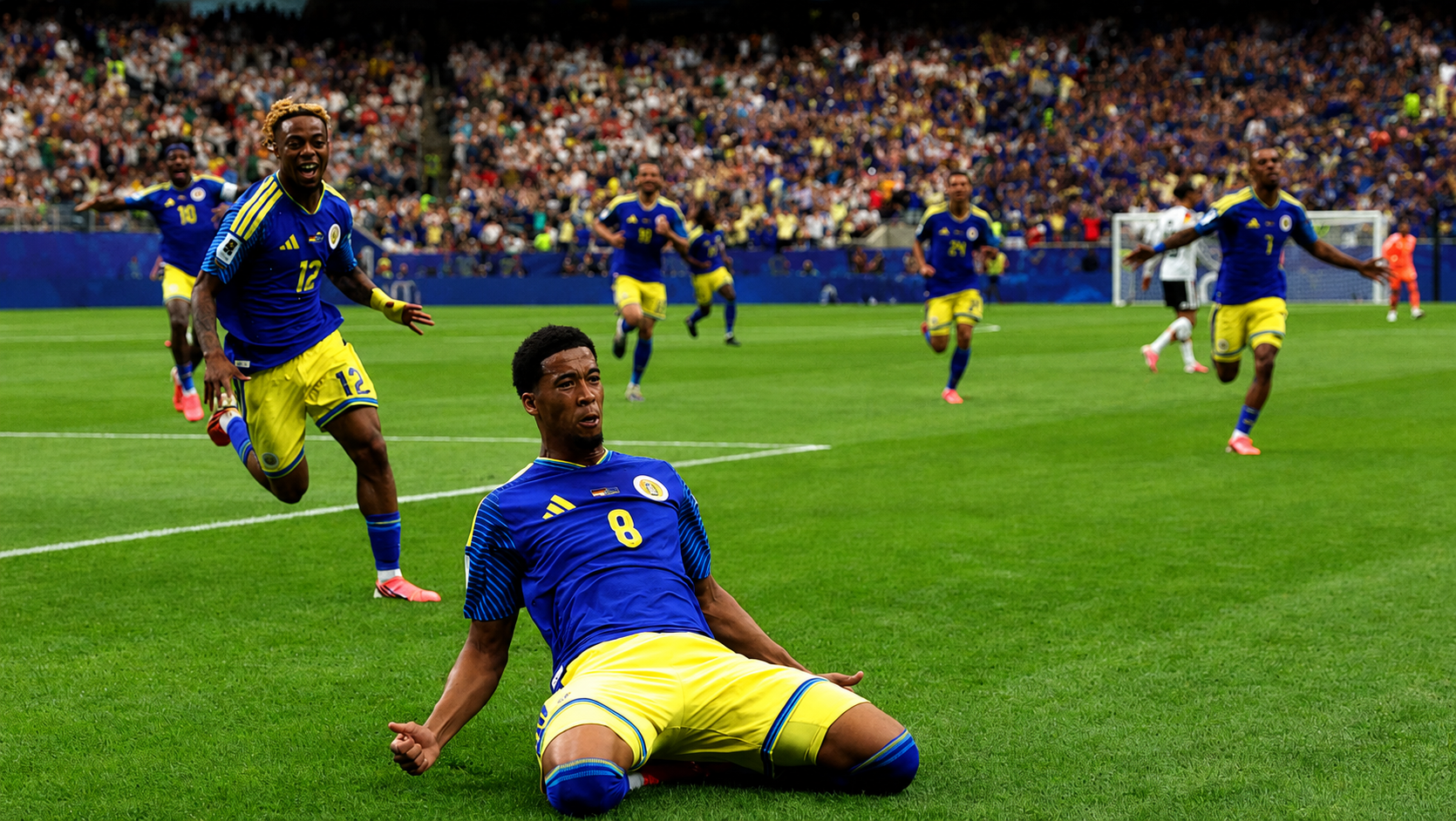
That is why Livano Comenencia’s goal against Germany mattered so much. Germany had already taken the lead, and the match seemed ready to follow a familiar script in which a major power controls the narrative. Instead, Comenencia changed it with one decisive contribution that gave Curaçao their first tournament goal.
The significance went beyond the scoreboard. For a smaller football nation, scoring against one of the sport’s most decorated teams instantly becomes part of national memory. It tells players back home that qualification was not the end of the dream. They belonged on the stage, and they had the goal to prove it.
Comenencia now holds a place no one can take away. Long after results are forgotten, he will be remembered as the player who gave Curaçao its first World Cup celebration.
Congo DR’s 52-year wait ends: Yoane Wissa revives a long-silenced World Cup story
Some first World Cup goals are about debut excitement. Congo DR’s was about release.
The country had waited 52 years to return to the tournament after appearing as Zaire in 1974. That history made their search for a first World Cup goal feel heavier than most. This was not simply a new participant looking for a breakthrough. It was a football nation reconnecting with a chapter left unfinished for generations.
When the goal finally arrived, it came through Yoane Wissa, who powered home a header from Arthur Masuaku’s cross. The finish itself was forceful and direct, the kind of goal that seemed to carry all the frustration and hope of that long absence.
Wissa’s celebration added another layer of meaning. He marked the moment with the Fimbu dance, turning a historic sporting achievement into a cultural expression as well. In that instant, the goal belonged not only to the player and the team, but to the broader identity of Congolese football.


For Congo DR supporters, the wait had stretched across eras, names and generations. Wissa’s header did more than end a statistical drought. It reintroduced the nation to the World Cup in the way every team wants to be remembered: by scoring, celebrating and feeling seen.
Jordan’s fitting hero: Ali Olwan scores the goal his journey deserved
Jordan’s first World Cup goal carried a different kind of logic. It felt right.
Ali Olwan had already been central to the country’s journey by finishing as Jordan’s top scorer in qualifying. When a nation reaches its debut World Cup, supporters naturally hope that one of the players who helped open the door will also define the first big moment once they get there.
That is exactly what happened. Olwan became the scorer of Jordan’s first World Cup goal, linking the qualification story to the finals in the most satisfying way possible.
There is a special symmetry in those moments. Rather than an unexpected name arriving from nowhere, it was the forward who had already shouldered responsibility for Jordan’s attack. That made the goal feel earned not only in the match itself, but across the full path that brought Jordan to the tournament.
For Jordanian football, the strike was a landmark that validated years of progress. For Olwan, it was the kind of contribution that permanently elevates a player from key performer to national football reference point.
More than a goal: what these World Cup firsts say about modern international football
The expansion of the World Cup has created room for more nations to dream, but qualification alone does not guarantee emotional payoff. A first goal is often the moment that turns participation into belonging.
For nations such as Curaçao, Congo DR and Jordan, these breakthroughs showed different sides of what World Cup 2026 can mean:
- Recognition: smaller or less-heralded countries can produce moments that resonate worldwide.
- Validation: long qualification campaigns gain historical weight when they lead to something tangible on the pitch.
- Identity: the scorer becomes part of national football folklore almost instantly.
- Inspiration: future players grow up knowing their country has already broken through on the biggest stage.
That is why first World Cup goals are remembered so clearly. Fans may debate tactics, results and rankings in the short term, but history often keeps the simpler milestones alive for longer. The first goal stands as proof that a nation crossed a line it had never crossed before.
The first World Cup goal scorers who became national symbols overnight
Livano Comenencia — Curaçao
The player who gave the smallest nation in the tournament a lasting World Cup memory, and did it against Germany after his side had fallen behind.
Yoane Wissa — Congo DR
The forward who ended a 52-year wait with a powerful header from Arthur Masuaku’s cross, then celebrated with the Fimbu dance.
Ali Olwan — Jordan
Jordan’s top scorer in qualifying and, fittingly, the man who scored the country’s first-ever World Cup goal at its debut finals.
Final word on World Cup 2026 first goals
While some countries arrive at the World Cup chasing trophies, others arrive chasing a first line in the history books. At World Cup 2026, Curaçao, Congo DR and Jordan found that line through goals that meant far more than numbers on a match report.
For these nations, one finish was enough to become part of football history forever. That is the power of a first World Cup goal: it turns a tournament appearance into a national memory that will outlive the competition itself.