Quick summary:
- FIFA is changing the World Cup 2026 yellow card rule to reduce suspensions in major knockout matches.
- Single yellow cards will now be wiped twice during the tournament.
- The first reset comes after the group stage.
- The second reset comes after the quarter-finals.
- Players still serve a one-match ban if they pick up two yellow cards in different matches before a reset point.
- The change is linked to the expanded 48-team format, which adds a new round of 32.
- The aim is to keep more top players available for the latter stages, including the semi-finals and final.
FIFA’s World Cup 2026 yellow card rule change is one of the most important tournament updates for fans, coaches, punters, and squad planners. On the surface, it looks like a technical disciplinary adjustment. In reality, it could have a major impact on team selection, player availability, and the balance of power in the knockout rounds.
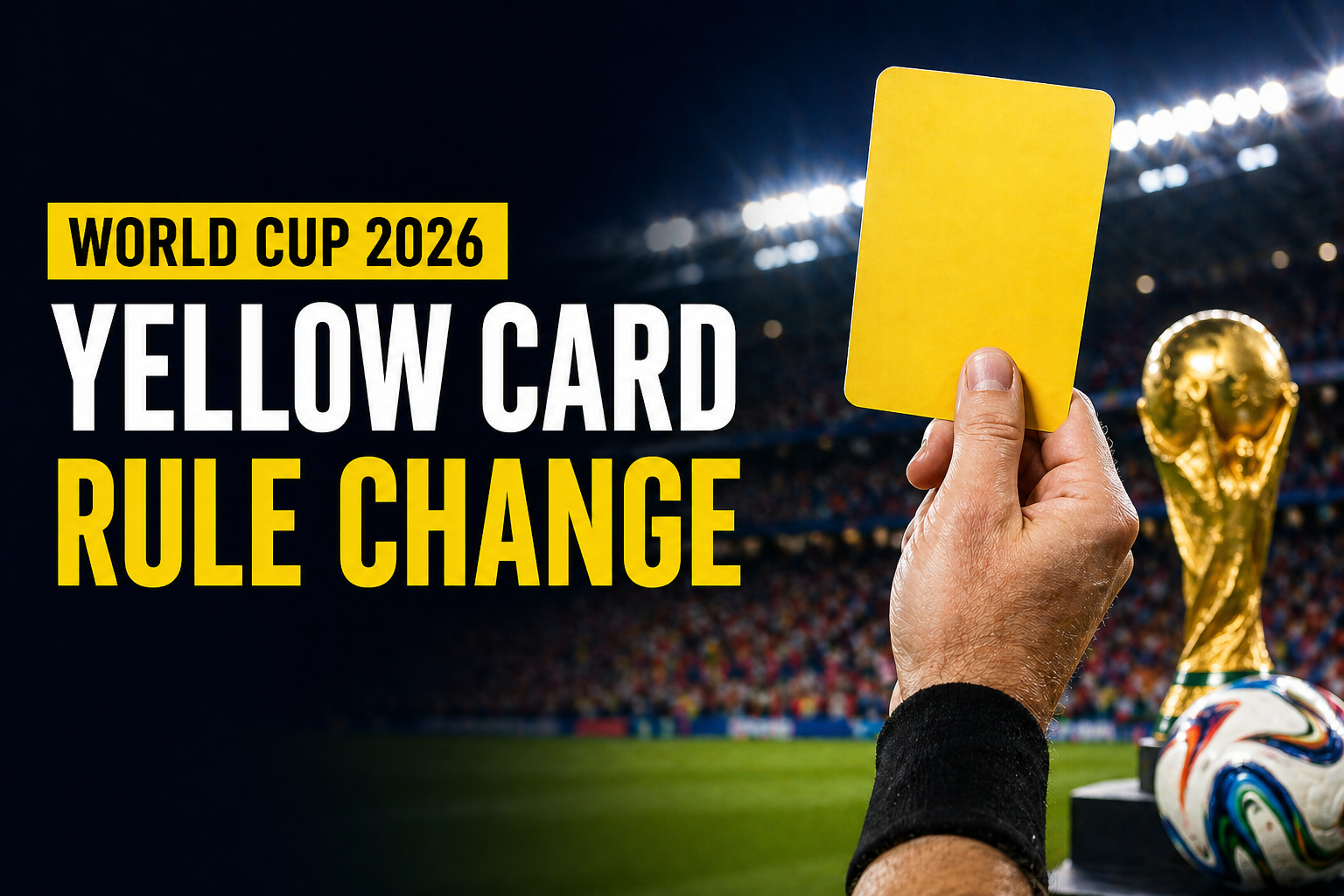
With the 2026 FIFA World Cup expanding to 48 teams and introducing an extra knockout round, FIFA has decided the old booking system no longer fit the shape of the tournament. The governing body’s answer is simple: wipe single yellow cards twice, once after the group stage and again after the quarter-finals.
That means fewer players will miss the biggest matches because of accumulated cautions, while teams should have a better chance of fielding their strongest lineups when the stakes are highest.
World Cup 2026 will run from 11 June to 19 July across the United States, Canada, and Mexico, and this disciplinary update is already shaping how analysts, bettors, and national team managers evaluate the road to the final.
What is the World Cup 2026 yellow card rule change?
The key update is that single yellow cards will be reset twice during the tournament.
Under FIFA’s revised approach:
- First reset: after the group stage
- Second reset: after the quarter-finals
In practical terms, a player who is booked once in the group stage will not carry that caution into the round of 32. Later in the tournament, players who reach the semi-finals will also do so with a clean slate for accumulated single yellows, assuming they had not already triggered a suspension before that reset point.
This is designed to stop players from missing elite knockout fixtures simply because they collected separate cautions across a long tournament path.
How the new World Cup yellow card reset works
First yellow-card reset: after the group stage
Once the group stage ends, all single yellow cards are wiped. That means teams entering the round of 32 start the knockout phase without players carrying forward a lone caution from the opening round.
This matters more in 2026 because there is now an extra elimination game before the round of 16. Without a reset, players would have faced a longer path while walking a suspension tightrope much earlier.
Second yellow-card reset: after the quarter-finals
FIFA will also clear single yellow-card accumulations after the quarter-finals. This is the part of the rule change that may have the biggest competitive effect.
It sharply reduces the chance of star players missing a semi-final or final due to a second caution picked up over several matches. Instead of suspensions looming over the tournament’s biggest stages, more teams should have their key names available when titles are on the line.
What stayed the same?
The updated rule does not remove yellow-card suspensions entirely.
Players will still receive a one-match ban if they collect two yellow cards in different matches before a reset point. So discipline still matters, especially in the group stage and across the earlier knockout rounds.
For example:
- A player booked in Group Match 1 and Group Match 3 would still be suspended before the reset applies.
- A player booked in the round of 32 and then again in the round of 16 could still trigger a one-game ban before the quarter-final reset.
- Serious misconduct rules, such as red cards, remain separate and can still lead to suspensions.
So while FIFA is reducing the risk of accumulation-based absences in marquee matches, it is not giving players a free pass to commit repeated fouls.
How the old World Cup yellow card rule worked
At previous World Cups, the yellow-card accumulation system was less forgiving over the course of the knockout bracket. Players could carry booking risk deeper into the competition, increasing the chance that a star would miss a huge match because of cautions picked up over multiple rounds.
That structure made more sense in a smaller tournament format. But with 2026 adding another knockout hurdle, keeping the old system would have increased the odds of suspensions at exactly the point fans, broadcasters, and teams least want them.
In short, the old rule was built for a shorter road. The new one reflects a longer tournament journey.
Why FIFA reviewed the rule ahead of World Cup 2026
The biggest driver is the expanded 48-team format.
World Cup 2026 will feature more teams and an added round of 32, which means finalists may need to navigate more high-pressure matches than in previous editions. That creates more chances for players to collect cautions, and therefore more chances for important games to be shaped by suspension lists rather than football quality.
FIFA’s updated policy appears aimed at balancing two priorities:


- Maintaining discipline by still punishing repeated bookings before reset points
- Protecting the spectacle by reducing the risk of top players missing major knockout matches
From a tournament management perspective, the change is logical. More matches create more accumulation pressure, so the disciplinary framework had to evolve as well.
What the rule means for each stage of the tournament
Group stage
The group stage still matters for discipline, but the consequences are now more contained. Players can still be suspended if they receive two yellows before the first reset, yet a single caution no longer follows them into the knockout bracket.
That may encourage coaches to be slightly more comfortable sticking with aggressive ball-winners or defenders who play on the edge, knowing one group-stage booking will not haunt them in the round of 32.
Round of 32
This is the new stage introduced by the expanded World Cup format. Because of the post-group reset, teams begin this round with a cleaner slate than they otherwise would have under an older-style system.
That reduces artificial squad disruption and helps ensure qualification stories from the group phase are not immediately derailed by accumulation-related absences.
Round of 16
Booking management starts to become more delicate again here. A caution in the round of 32 plus another in the round of 16 can still result in a suspension before the quarter-finals. Coaches may rotate, substitute earlier, or ask certain players to avoid unnecessary tactical fouls when protecting a lead.
Quarter-finals
The quarter-finals remain a danger zone for players already on a yellow in the knockout phase. But after this round, FIFA’s second reset clears single cautions.
That is a huge competitive shift. It means players who make it through the quarter-finals without triggering a suspension can enter the semi-finals without carrying accumulated yellow-card baggage.
Semi-finals
This is where the new rule could be most appreciated. In previous tournament structures, the fear of missing the final sometimes shaped how players approached a semi-final. With the second reset after the quarter-finals, there is less chance of a player being ruled out of a semi or final due to earlier accumulation patterns.
Final
The final should benefit most from FIFA’s intention. The revised yellow-card rule increases the likelihood that both finalists can field their best available teams, instead of seeing a title match altered by cumulative bookings collected in prior rounds.
How coaches and teams could benefit
For national team managers, this is more than an admin tweak. It affects strategy.
Possible benefits include:
- More lineup stability in knockout football
- Less forced rotation due to yellow-card risk
- More freedom for key midfielders and defenders to play naturally
- Better chance of star-player availability in semi-finals and the final
- Cleaner squad planning across a longer tournament path
That matters because many of the game’s most influential players operate in positions where yellow cards are common. Defensive midfielders, centre-backs, and full-backs often collect cautions through tactical challenges, transition fouls, or repeated physical duels. Under the new setup, a single booking is less likely to snowball into a major tournament absence.
How the World Cup 2026 yellow card rule change affects betting and tournament analysis
For readers following outright markets, match odds, player props, or team specials, this rule change is worth factoring in.
Why? Because player availability deep into the tournament can affect:
- Outright winner probabilities
- Semi-final and final qualification markets
- Anytime goalscorer and assist props
- Player card betting angles
- Team performance projections in knockout rounds
A squad with elite but card-prone defenders or midfielders may now be slightly less vulnerable to late-tournament disruption than under the older framework. When comparing futures prices or evaluating dark-horse teams, disciplinary carry-over is one more variable to keep in mind.
For bettors, the smart angle is not assuming the rule makes cards irrelevant. Instead, it shifts when caution risk matters most. The group stage and the round-of-32-to-quarter-final corridor become especially important for suspension tracking.
Will the rule make the World Cup better?
There is a strong argument that it will.
Fans generally want the biggest matches to feature the biggest players. Coaches want selection decisions to be driven by form, fitness, and tactics rather than administrative accumulation. Broadcasters want showcase fixtures at full strength. And FIFA wants a tournament where the football, not the paperwork, takes centre stage.
Critics may argue that softer accumulation rules reduce the punishment for persistent fouling over a long event. That is fair to a point. But because two yellows before a reset still trigger a ban, disciplinary accountability remains in place.
Overall, FIFA seems to have chosen a middle ground: keep consequences for repeated cautions, but stop the longest World Cup in history from over-penalising players simply for surviving multiple rounds.
Final thoughts on the World Cup 2026 yellow card rule change
The World Cup 2026 yellow card rule change is not just a technical footnote. It is a structural update built for a new-look tournament.
By resetting single yellow cards after the group stage and after the quarter-finals, FIFA is trying to reduce unnecessary suspensions in the games that matter most. With the 48-team format creating an extra round of 32, that adjustment feels less like a luxury and more like a practical necessity.
The result should be a fairer flow to the knockout rounds, more stars available in the latter stages, and fewer scenarios where a World Cup semi-final or final is shaped by accumulated bookings from earlier matches.
As the tournament approaches from 11 June to 19 July in the United States, Canada, and Mexico, this will be one of the key rule changes for fans and bettors to watch closely.