World Cup 2026 third-place standings matter because finishing third in a group no longer means automatic elimination. This guide explains how the third-place standings work, why the top eight third-place teams can still qualify for the Round of 32, and which FIFA tiebreakers decide who goes through.
Because the table can shift after every matchday, the third-place race will stay live until the final group games are complete. That means one draw, one late goal, or even a cleaner disciplinary record can make the difference between advancing and going home.
Why World Cup 2026 Third-Place Standings Matter
The biggest change at the 2026 World Cup is expansion. FIFA has increased the tournament from 32 teams to 48 teams, creating 12 groups of four teams instead of the old eight-group setup.
That expansion changes the knockout bracket too. In previous World Cups, teams went from the group stage straight into the Round of 16. In 2026, the knockout phase starts earlier, with a new Round of 32.
This is why third-place standings suddenly matter so much. With more teams in the tournament and a larger knockout stage, FIFA has created an extra qualification route for teams that do not finish in the top two of their group.
How teams qualify from the group stage
The basic qualification rule is simple:
- The top two teams in each of the 12 groups qualify automatically.
- That produces 24 automatic qualifiers.
- The eight best third-place teams also qualify.
- Those eight teams fill the remaining spots in the Round of 32.
So even if a team finishes third, it can still advance. That is the key point many fans will be searching for during the tournament.
In practical terms, teams fighting for third are not just competing inside their own group. They are also competing against the third-place teams from the other 11 groups.
What the World Cup 2026 third-place standings mean
The third-place standings are a separate ranking table made up only of the teams sitting third in their groups. Once every group has played, FIFA compares those 12 third-place teams against each other.
The top eight teams in that third-place table move into the Round of 32. The bottom four are eliminated.
That is why the third-place table can be so dramatic. A team that looks safe after one round of matches can slide out of the top eight later. Likewise, a team outside the qualification places can climb back in with a win, a draw, or even a narrower defeat than its rivals.
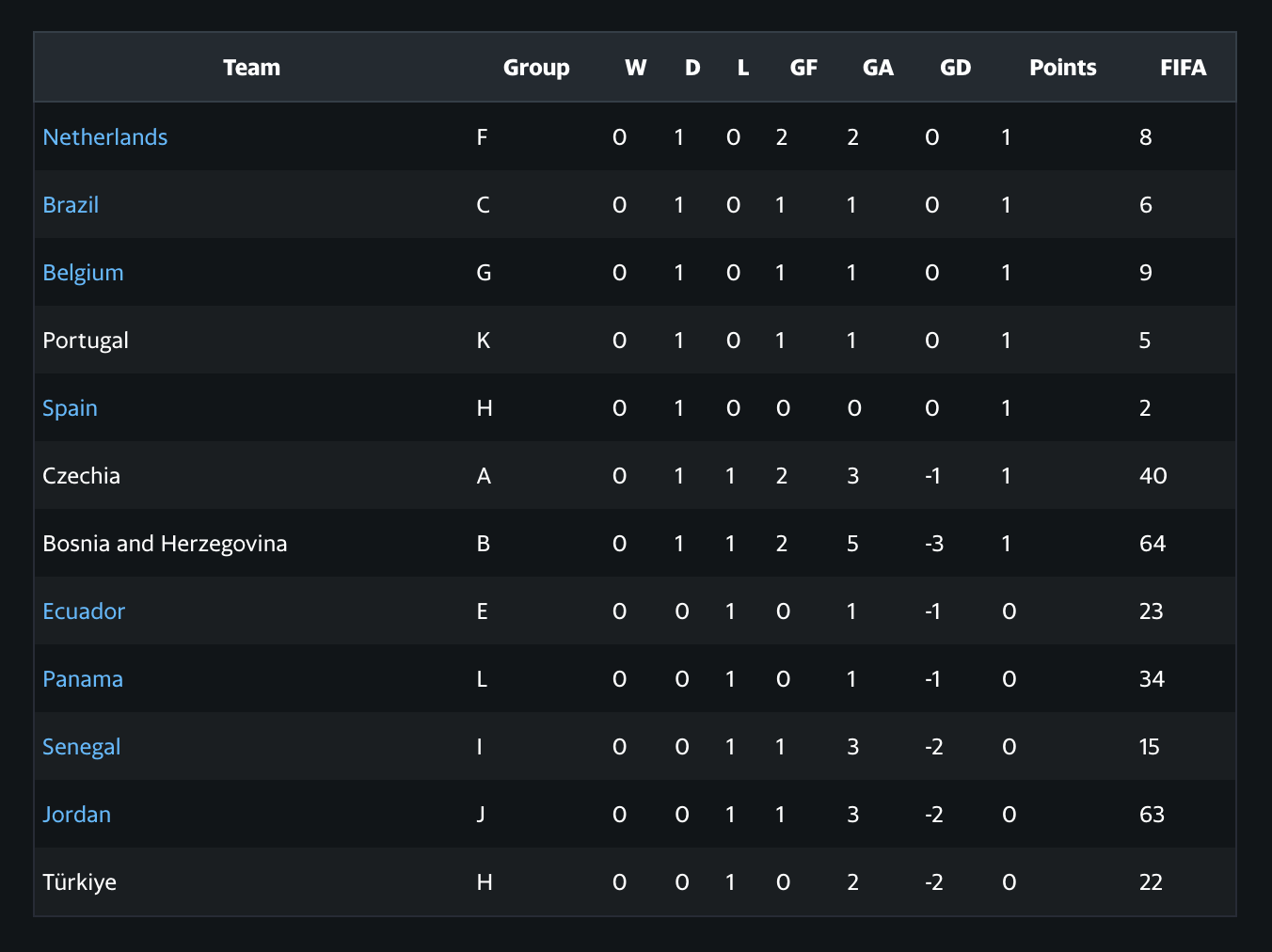
As the latest scoreboard shows, the margins can be tight, which is exactly why fans should keep checking the third-place standings throughout the group stage rather than focusing only on first and second in each group.
How FIFA ranks third-place teams
FIFA uses a straightforward order of tiebreakers to rank third-place teams. If two or more teams finish level, they are separated using the following criteria:
- Most points
- Better goal difference
- More goals scored
- Better team conduct score
- FIFA World Ranking if teams are still tied
Here is what each one means in simple terms.
1. Most points
This is the first thing that matters. A third-place team with 4 points will rank above a third-place team with 3 points. Likewise, 3 points beats 2, and 2 beats 1.
That is why even a single draw can be valuable. In a format where eight third-place teams qualify, getting to 4 points often gives a team a strong chance of advancing, while 3 points may leave it sweating on other results.
2. Goal difference
If teams are level on points, FIFA looks at goal difference. This is goals scored minus goals conceded.
For example:
- A team that scores 3 and concedes 2 has a goal difference of +1.
- A team that scores 2 and concedes 4 has a goal difference of -2.
This is why a narrow loss can be much better than a heavy defeat. If two third-place teams both finish on the same points, the one that kept scorelines tighter may end up advancing.
3. More goals scored
If points and goal difference are both equal, FIFA then compares total goals scored.
This can make late goals surprisingly important. Even a goal in a losing effort can help a third-place team if it later ends up tied on points and goal difference with another side.


For casual fans, this is one of the easiest ways to understand the drama: teams do not always stop pushing when they are behind, because one goal can improve their position in the third-place race.
4. Better team conduct score
If teams are still tied, FIFA moves to the team conduct score, sometimes called the fair play or disciplinary tiebreaker.
In simple terms, fewer disciplinary issues are better. Yellow cards and red cards can hurt a team’s ranking if everything else is level.
You do not need to overcomplicate it. The practical takeaway is this: cards matter. A team with fewer cautions and dismissals can finish above a rival on the third-place table if they are tied on points, goal difference and goals scored.
That means players, coaches and fans may suddenly care a lot about needless bookings in the final group match.
5. FIFA World Ranking
If teams are still somehow tied after all the on-field and disciplinary criteria, FIFA can use the FIFA World Ranking as the final separator.
This is expected to be rare, but it is still part of the rules and could matter in an unusually close third-place race.
Why third-place standings can change so quickly
One reason this format may confuse fans at first is that the third-place table is not settled until every group-stage match is complete. Teams play at different times, and the rankings can swing sharply after each result.
A team might sit inside the top eight after matchday one simply because others have not played yet. Another side could be outside the qualification spots early, then jump into the top eight with one strong result in its second or third match.
That is why it is important not to overreact too early. The third-place race is highly fluid.
Here is what can change a team’s position quickly:
- Turning a loss into a draw
- Scoring a late goal to improve goal difference
- Avoiding a heavy defeat
- Picking up an extra goal scored in a close game
- Keeping discipline and avoiding unnecessary cards
Why a draw, narrow loss, or late goal matters so much
Under the old 32-team World Cup format, teams often needed to finish in the top two or they were out. In 2026, the third-place route changes the math.
That creates more survival scenarios:
- A draw can move a team from 2 points to 3, or from 3 to 4, which may be enough to reach the Round of 32.
- A narrow loss may keep goal difference respectable compared with other third-place teams.
- A late consolation goal can boost total goals scored, which may become a critical tiebreaker.
- A disciplined performance can preserve a better conduct score for tight ranking situations.
For fans following live standings, this means group-stage matches can remain meaningful deep into stoppage time, even when the winner appears decided.
How to read the standings without getting confused
If you want the simplest way to follow the World Cup 2026 third-place standings, use this checklist:
- Check which team is currently third in each group.
- Compare their points totals first.
- If teams are level, compare goal difference.
- If still level, compare goals scored.
- If still level, look at team conduct.
- Remember that only the top eight third-place teams advance.
This approach makes the format easier to understand, especially for casual viewers who are used to the older Round of 16 setup.
A note on current team examples
As the tournament develops, readers may see teams such as Brazil, Belgium, Portugal, Bosnia and Herzegovina, Qatar, Czechia, Ecuador or Panama discussed in the third-place standings race. Those examples should only be used in live updates when their exact positions, points, goal difference and disciplinary records are fully verified.
That matters because the third-place table is highly sensitive to new results. One match can completely change the picture, and an outdated example can quickly become misleading.
What this means for fans, analysts, and bettors
The expanded format adds more tension to the group stage. Fans get more meaningful matches, broadcasters get more live qualification drama, and bettors have more angles to assess beyond simply picking group winners.
For anyone tracking odds or live markets, understanding the third-place standings can help explain why teams keep attacking late, why managers become cautious about discipline, and why a single goal can move prices quickly in in-play betting.
That does not mean every third-place team is likely to advance, but it does mean more teams stay alive longer. As a result, the final round of group fixtures should create more scoreboard-watching than previous World Cups.
Final takeaway
The World Cup 2026 third-place standings add a new layer to the tournament, but the core idea is simple: the top two teams in each group qualify automatically, and the eight best third-place teams also reach the Round of 32.
Once you know the ranking order of points, goal difference, goals scored, team conduct score and FIFA World Ranking, the format becomes much easier to follow. Until the final group matches are played, plenty of teams will still have a realistic path into the knockout stage.